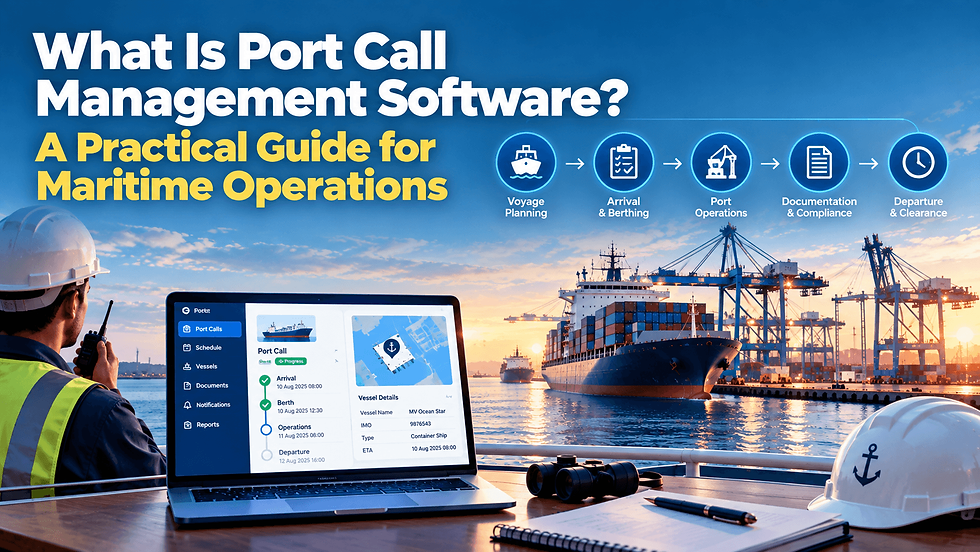
How a Port Call Works: A Step-by-Step Guide
A vessel arriving at a port may look like a simple event.
The ship arrives.
Cargo is handled.
Supplies are delivered.
The vessel departs.
But behind those few visible activities is a highly coordinated operational process involving the vessel, shipping company, port, terminal, agents, authorities, service providers, suppliers and many other stakeholders.
A port call brings all of these activities together within a limited period.
That makes port call management one of the most coordination intensive parts of maritime operations.
A delay in one activity can affect several others.
A missing document can hold up clearance.
A delayed service can affect the vessel schedule.
A change in ETA can require multiple stakeholders to adjust their plans.
Understanding how a port call works is therefore important for anyone working with maritime operations, shipping technology or digital transformation.
This guide explains the port call process from arrival planning to departure and shows where information, coordination and technology can make a difference.
What Is a Port Call?
A port call is the period during which a vessel arrives at a port and carries out the activities required before departing.
Depending on the vessel and port, these activities may include:
Arrival coordination
Berth planning
Pilot arrangements
Tug arrangements
Customs and immigration formalities
Port documentation
Cargo operations
Bunkering
Fresh water supply
Waste disposal
Crew-related services
Stores and provisions
Repairs or technical services
Inspections
Departure clearance
The exact activities vary by vessel, port, cargo and local requirements.
But the underlying challenge is similar:
Many activities need to happen at the right time, in the right sequence, with the right information.
Who Is Involved in a Port Call?
A port call is rarely managed by one organization.
Several parties may be involved.
Vessel and Crew
The vessel provides information about its arrival, requirements, cargo, condition and operational needs.
The crew also coordinates onboard activities during the port stay.
Ship Owner or Operator
The shipping company may need visibility into schedules, costs, services, cargo operations and operational exceptions.
Port Authority
The port authority manages port related requirements and coordination according to local procedures.
Terminal
For cargo carrying vessels, the terminal coordinates cargo related operations and berth activities.
Shipping Agent
The agent often acts as a coordination point between the vessel, port, authorities and service providers.
Pilots and Tug Operators
These services support vessel movement during arrival, berthing, shifting and departure where required.
Suppliers and Service Providers
These can include companies providing:
Bunkers
Fresh water
Waste services
Stores
Spare parts
Repairs
Crew transportation
Other vessel services
The number of participants can make information coordination challenging.
Step 1: Voyage and Port Planning
A port call begins before the vessel reaches the port.
The shipping company and vessel need to understand:
When will the vessel arrive?
What does the vessel require?
What cargo operations are expected?
Which services need to be arranged?
What documents are required?
Are there any special port requirements?
Planning allows stakeholders to prepare before the vessel arrives.
The earlier relevant information is available, the more effectively activities can be coordinated.
Step 2: ETA Communication
One of the most important pieces of information in port operations is the vessel's Estimated Time of Arrival, or ETA.
ETA can change.
Weather may affect the voyage.
The vessel may experience operational delays.
Traffic conditions can change.
The previous port may take longer than expected.
When ETA changes, other activities may also need to change.
A revised ETA may affect:
Berth planning
Pilot arrangements
Tug arrangements
Cargo operations
Bunkering
Supplier deliveries
Crew services
Transportation
Departure planning
This is why ETA is not simply a number.
It is an operational dependency.
Step 3: Pre Arrival Documentation
Before arrival, the required information and documentation need to be prepared and submitted.
Depending on the port and vessel, this may involve information related to:
Vessel particulars
Crew
Cargo
Previous ports
Arrival information
Health requirements
Customs
Immigration
Security
Port formalities
Much of this information may move between organizations.
If information is manually entered multiple times, errors and delays can occur.
Step 4: Berth Planning
The vessel needs a place to berth.
Berth availability depends on several factors.
For example:
Vessel size
Draft
Cargo
Terminal availability
Existing vessel movements
Port restrictions
Expected arrival time
Berth planning therefore depends on accurate and timely information.
A change in one part of the schedule can affect the wider port plan.
Step 5: Pilot and Tug Coordination
Depending on the port, pilot and tug services may be required.
The timing of these services needs to align with vessel arrival and berthing plans.
This creates another coordination dependency.
If the vessel arrives earlier or later than expected, arrangements may need to be adjusted.
The challenge is not simply booking the service.
It is keeping the service aligned with the latest operational situation.
Step 6: Vessel Arrival
When the vessel approaches the port, the planned arrival activities begin.
This may involve:
Pilot boarding
Tug assistance
Port entry
Navigation coordination
Berthing
The exact process depends on the port and vessel.
At this stage, accurate communication becomes particularly important.
Step 7: Berthing
Once the vessel reaches the designated berth, the port stay begins.
The vessel may now have multiple activities planned.
For example:
Cargo operations
Bunkering
Stores delivery
Waste collection
Crew services
Repairs
The challenge is coordinating these activities without creating unnecessary conflicts.
Step 8: Cargo Operations
For cargo vessels, cargo operations are often a major part of the port call.
Depending on the vessel and trade, this can include:
Loading
Discharging
Cargo inspection
Documentation
Terminal coordination
Cargo operations can affect the expected departure time.
If cargo operations take longer than planned, downstream activities may need to be adjusted.
Step 9: Marine Services
During the port stay, the vessel may require several marine services.
These can include:
Bunkering
Fuel is supplied to the vessel.
Fresh Water
Fresh water may be supplied where required.
Waste Services
Waste may be collected and handled according to port requirements.
Stores
Food, consumables or other supplies may be delivered.
Technical Services
Repairs, inspections or maintenance support may be arranged.
Each service introduces another coordination requirement.
Step 10: Crew Related Services
A port call may also involve crew related activities.
Depending on the situation, these can include:
Crew changes
Transportation
Medical assistance
Accommodation
Documentation
Shore arrangements
These activities need to be coordinated alongside vessel operations.
Step 11: Customs, Immigration and Other Formalities
Regulatory and administrative processes are another part of the port call.
Authorities may require specific documentation or declarations.
The exact requirements vary by jurisdiction and port.
This creates an important operational requirement:
The right information must reach the right stakeholder at the right time.
Step 12: Departure Planning
As cargo and other activities approach completion, departure planning begins.
The team needs to understand:
Are all required activities complete?
Are documents ready?
Are services completed?
Is the vessel ready to sail?
Is pilot assistance arranged?
Are there any outstanding issues?
Departure is not simply the final step.
It depends on the successful completion of several preceding activities.
Step 13: Departure
Once the vessel is cleared and ready, departure activities begin.
This may involve:
Pilot arrangements
Tug assistance
Departure clearance
Final documentation
Unberthing
Port departure
The port call is complete when the vessel leaves the port and the associated operational records are finalized.
The Port Call Is a Chain of Dependencies
The most useful way to understand a port call is not as a list of independent tasks.
It is a connected chain.
For example:
ETA
↓
Berth Planning
↓
Pilot & Tug
↓
Berthing
↓
Cargo Operations
↓
Services
↓
Clearance
↓
Departure
But the chain is not always linear.
Some activities happen simultaneously.
Others depend on the completion of earlier activities.
Some can be rescheduled.
Others cannot.
This creates the operational complexity of a port call.
Why Port Calls Become Difficult to Manage
The complexity increases when information is fragmented.
A shipping agent may have one set of information.
The vessel may have another.
The terminal may use its own system.
Suppliers may communicate through email.
Authorities may use separate platforms.
Internal teams may maintain spreadsheets.
The result can be multiple versions of the same operational picture.
The challenge becomes:
Which information is current?
The Importance of a Shared Operational Picture
A strong port call process depends on shared visibility.
Different stakeholders may need to understand:
Current ETA
Berth status
Service status
Cargo progress
Documentation status
Outstanding requirements
Delays
Changes
Expected departure
Not every stakeholder needs access to everything.
But the right stakeholders need access to the information relevant to their responsibilities.
Where Technology Can Help
Technology does not change the physical activities of a port call.
A vessel still needs to berth.
Cargo still needs to be handled.
Services still need to be delivered.
But technology can improve how information moves between these activities.
For example, a port call platform can potentially bring together:
Vessel Information
Schedules
Services
Documents
Tasks
Status
Communication
into a more coordinated operational environment.
From Reactive Coordination to Proactive Coordination
Consider two different situations.
Reactive Model
A supplier discovers that the vessel's ETA has changed.
They send an email.
Someone reads it later.
Another stakeholder needs to be informed.
The schedule is updated manually.
The process continues.
Proactive Model
The ETA changes.
The relevant stakeholders receive the updated information.
Affected activities are identified.
The team can review what needs to change.
The difference is not necessarily automation of every decision.
It is better visibility.
Where AI Can Support Port Call Operations
AI can potentially help with information intensive parts of port call management.
For example:
Information Summarization
AI could summarize updates from multiple communications.
Document Processing
AI could extract relevant information from port documents.
Exception Detection
AI could help identify activities that may require attention.
Natural Language Search
A user could ask:
"What is still pending for this vessel?"
or:
"Which port call activities could affect departure?"
Decision Support
AI could bring relevant information together to help teams evaluate operational situations.
The goal should be decision support rather than removing human accountability.
Why Data Quality Matters
Technology cannot create reliable operational visibility from unreliable information.
If:
ETA is outdated
service status is missing
documents are incomplete
vessel information is inconsistent
then even an advanced system can produce limited value.
This is why port call digitalization should begin with understanding the workflow and information requirements.
Port Call Management Is More Than Scheduling
It is tempting to think of port call management as a scheduling problem.
Scheduling is important.
But port calls also involve:
People
Information
Documents
Services
Compliance
Communication
Dependencies
Exceptions
A useful port call system therefore needs to consider the entire operational workflow.
Measuring Port Call Performance
Organizations can evaluate port call performance using different operational measures.
Depending on the operation, these might include:
Planned arrival versus actual arrival
Planned departure versus actual departure
Time alongside
Service completion times
Cargo operation duration
Waiting time
Documentation delays
Number of operational exceptions
The specific metrics should reflect the organization's goals.
The important principle is to measure the areas where visibility can lead to improvement.
A Practical Digital Port Call Model
A modern port call workflow can be thought of in five layers.
1. Plan
Understand the expected arrival, requirements and activities.
2. Coordinate
Align vessels, agents, terminals, authorities, suppliers and service providers.
3. Execute
Track what is happening during the port stay.
4. Monitor
Identify changes, delays, exceptions and outstanding activities.
5. Learn
Use historical port call information to understand patterns and improve future planning.
The fifth stage is often overlooked.
A completed port call creates historical operational data.
That data can help improve future port calls.
Port Calls Generate Valuable Operational Data
Every port call can generate information about:
Timing
Services
Costs
Delays
Suppliers
Ports
Vessel requirements
Operational exceptions
If this information is consistently captured, it becomes more useful over time.
A company can begin asking:
Where do delays repeatedly occur?
Which services create the most coordination effort?
Which ports have recurring issues?
Which activities frequently affect departure?
This turns historical records into operational intelligence.
The Future of Port Call Management
The future is unlikely to be about replacing every human involved in port operations.
It is more likely to be about creating better connected systems.
A more mature port call environment could combine:
Real Time Information
Workflow Management
Data Integration
Automation
AI Decision Support
Human Oversight
This approach can help maritime teams move from constantly reacting to updates toward anticipating what may require attention.
Final Takeaway
A port call is much more than a vessel arriving and leaving a port.
It is a coordinated operational workflow involving multiple organizations, services, documents, schedules and dependencies.
The process begins before arrival and continues until departure and record completion.
The central challenge is coordination.
When information is fragmented, even experienced teams can spend significant effort chasing updates, confirming status and resolving inconsistencies.
When information is structured, connected and visible, the same operational process can become easier to coordinate and understand.
Technology can support this transition through workflow management, integration, automation, analytics and AI based decision support.
But the foundation remains the same:
Understand the workflow first.
Connect the information.
Make the operational picture visible.
Then automate and apply AI where it genuinely helps.
That is the path from port call coordination to more intelligent maritime operations.
FAQ
1. What is a port call?
A port call is the period during which a vessel arrives at a port, completes required operational and administrative activities, and prepares for departure.
2. What happens during a port call?
A port call can include arrival coordination, berth planning, pilot and tug arrangements, cargo operations, bunkering, supplies, repairs, crew services, documentation, clearance and departure activities.
3. Who is involved in a port call?
Depending on the vessel and port, stakeholders can include the vessel and crew, ship owner or operator, shipping agent, port authority, terminal, pilots, tug operators, suppliers, service providers and regulatory authorities.
4. Why is ETA important in port call operations?
ETA is important because changes in the vessel's expected arrival can affect berth planning, pilot and tug arrangements, cargo operations, suppliers, services and departure planning.
5. What is port call management?
Port call management is the coordination of vessel arrival, berth activities, services, documentation, cargo operations, stakeholders, exceptions and departure requirements during a vessel's port stay.
6. How can technology improve port call operations?
Technology can help connect vessel information, schedules, tasks, documents, services and operational status, giving relevant stakeholders better visibility and coordination.
7. Can AI be used in port call management?
AI can potentially support document processing, information summarization, exception identification, natural language search and decision support, while human teams remain responsible for operational decisions.
8. What data is generated during a port call?
A port call can generate information about vessel timing, services, cargo activities, delays, suppliers, costs, documentation and operational exceptions.