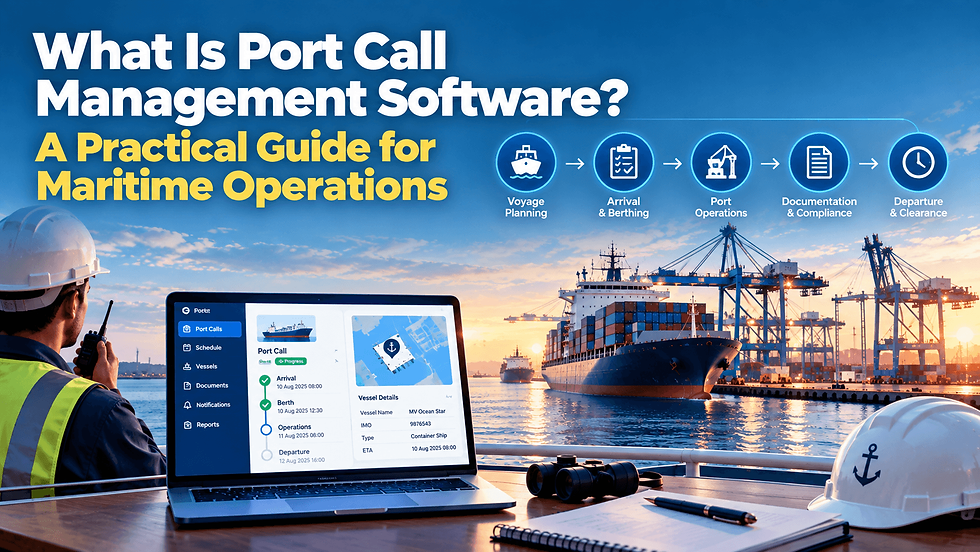
What Does Digital Transformation Really Mean for a Maritime Company?
A company that replaces its paper logbook with a digital form has changed the format of its information.
That does not necessarily mean it has transformed the way it operates.
The distinction matters.
A procurement team may replace a paper request with an Excel sheet. A shipping agency may replace a printed document with a PDF. An operations team may exchange phone calls for email.
Everything is now digital.
But the underlying workflow may still be exactly the same.
People still enter the same information manually. Teams still follow up by email. Data still sits in different systems. Decisions still depend on individuals finding and combining information themselves.
This is where the difference between digitalization and digital transformation becomes important.
Digital transformation in maritime is not simply about replacing paper with software. It is about using technology to change how information moves, how workflows operate, how decisions are made and ultimately how the business performs.
For maritime companies, that distinction is particularly important because operations rarely happen inside one system or even within one organization. Vessel operations, procurement, port calls, documentation and customer coordination can involve multiple teams, companies and technology environments.
The real question is therefore not:
“Have we digitized this process?”
It is:
“Has technology actually changed how this process works?”
Digitalization vs Digital Transformation
Digitalization and digital transformation are often used as if they mean the same thing. They do not.
What is digitalization?
Digitalization generally means converting information or an existing manual process into a digital format.
Examples include:
Replacing a paper ledger with a spreadsheet
Scanning paper documents
Sending documents by email instead of fax
Creating a PDF version of an existing form
Moving records into a digital database
Using an online form instead of a printed form
These changes can be useful.
Digital information is generally easier to store, search, distribute and access.
But the underlying workflow may remain unchanged.
The people may still perform the same steps.
The same approvals may still be required.
The same information may still have to be entered several times.
The same communication gaps may still exist.
What is digital transformation?
Digital transformation goes further.
It uses digital capabilities to change how an organization actually operates and makes decisions.
That can involve:
Connecting previously separate systems
Integrating operational data
Reducing unnecessary manual handoffs
Modernizing legacy applications
Automating repetitive workflows
Improving access to information
Creating better operational visibility
Using data to support decisions
Applying AI where it genuinely fits
Redesigning workflows rather than simply digitizing them
A simple distinction is:
Digitalization changes the format. Digital transformation changes the way the business works.
This difference is central to any serious maritime technology strategy.
Why Maritime Digital Transformation Is Different
Generic digital transformation frameworks do not always translate directly into maritime.
A typical enterprise transformation model may assume that most processes sit within one organization, with relatively direct control over employees, systems and data.
Maritime operations are often more distributed.
A single operational process can involve:
Vessel teams
Ship owners
Ship managers
Fleet teams
Shipping agents
Ports
Suppliers
Service providers
Customers
Authorities
Each participant may use different systems and follow different processes.
That creates a unique challenge.
The business process can be connected even when the technology supporting it is not.
Consider a port call.
A shipping agency may coordinate vessel information, port requirements, service providers, documentation, customer communication and financial information.
The process itself is one operational activity.
The information supporting it may be scattered across emails, spreadsheets, documents and different applications.
The same issue can appear in marine procurement.
An enquiry can lead to an RFQ, supplier communication, quotations, comparisons, approvals, purchasing, delivery and invoicing.
If every step is handled separately, the organization may have plenty of digital information but limited visibility into the complete workflow.
This is why maritime digital transformation needs to look at information flow across the ecosystem, not just software inside individual departments.
An Eight Stage Framework for Maritime Digital Transformation
Digital transformation does not have to begin with a large technology implementation.
A more practical approach is to treat it as a sequence:
Understand → Prioritize → Connect → Modernize → Automate → Apply AI → Measure → Evolve
Each stage creates a foundation for the next.
1. Understand How Work Actually Happens
Before deciding what technology to implement, understand the current operation.
This means looking beyond the official process documentation.
The documented process might say:
Customer Enquiry → RFQ → Quotation → Approval → Purchase
But the real process could look more like:
Email → Excel → Phone Call → Supplier Follow-up → Personal Spreadsheet → Approval Email → Another Spreadsheet → Customer Update
The difference between these two processes is where valuable transformation opportunities can often be found.
Start by mapping:
Current workflows
Existing systems
Data sources
Manual activities
Repetitive tasks
Communication channels
Bottlenecks
Workarounds
Approvals
Dependencies on individual employees
The goal is to understand the operation honestly, including the informal processes that may never appear in official documentation.
2. Prioritize the Problems That Matter
Once the current state is understood, the next step is deciding what actually deserves attention.
Not every process needs to be transformed at the same time.
A useful question is:
Which problems have the greatest business impact?
Consider factors such as:
Time consumed
Operational delays
Cost
Risk
Errors
Customer impact
Frequency
Data visibility
Compliance requirements
Strategic importance
A process may be technically interesting but have little business impact.
Another may look mundane but consume significant employee time every day.
Digital transformation should therefore begin with business priorities rather than technology trends.
The objective is not to find somewhere to use AI or automation.
The objective is to identify where technology can meaningfully improve the operation.
3. Connect the Systems and Data That Matter
Fragmented information is one of the biggest barriers to effective digital transformation.
A maritime company may have individual systems for different functions.
One system may manage operations.
Another may manage finance.
Another may handle procurement.
Another may store documents.
The problem may not be that any one system is ineffective.
The problem may be that they do not communicate effectively.
This can lead to:
Duplicate data entry
Manual reconciliation
Repeated document handling
Different versions of information
Limited visibility
Delayed decisions
Dependency on individual employees
Integration can address some of these gaps.
This does not necessarily mean replacing every existing application.
In many cases, connecting systems can create more value than replacing them all.
That makes APIs, data integration and connected digital platforms important components of a maritime technology strategy.
4. Modernize Valuable Legacy Systems
Legacy software is not automatically bad software.
Some legacy systems remain critical because they contain years of operational knowledge and support processes that the organization depends on.
The problem begins when those systems become difficult to maintain, integrate or adapt.
Modernization does not always mean replacing the entire application.
It can involve:
Updating an existing application
Replacing individual components
Extending existing functionality
Introducing APIs
Connecting legacy systems with modern platforms
Migrating selected workloads
Gradually replacing outdated components
This is where maritime companies need to make careful build, buy, integrate or modernize decisions.
The right answer depends on the business process, existing technology environment, risk and long-term strategy.
5. Automate What Is Well Understood
Automation is valuable when applied to the right type of process.
Good candidates often have characteristics such as:
Repetitive work
Clear rules
Predictable outcomes
High volume
Significant manual effort
Well-defined process steps
Examples might include repetitive data entry, notifications, document routing or defined approval activities.
But automation should not automatically be the first step.
If a workflow is poorly understood or contains inconsistent information, automation can simply reproduce the problem at greater speed.
The better sequence is:
Understand → Standardize → Connect → Automate
This gives automation a stronger foundation.
6. Apply AI Where It Actually Fits
AI has created new possibilities for maritime organizations.
But that does not mean every maritime workflow needs AI.
The better question is:
Where can AI solve a problem more effectively than conventional software or rules-based automation?
AI can be particularly relevant to work involving:
Unstructured information
Large volumes of documents
Information extraction
Classification
Search
Summarization
Knowledge management
Decision support
Complex information workflows
For example, a maritime organization dealing with large numbers of documents and emails may have opportunities to use AI to extract, organize or interpret information.
But AI should be introduced with appropriate human oversight.
An organization also needs to understand what information the AI is working with, what decisions it is supporting and how errors will be identified.
The objective should not be:
“Where can we use AI?”
It should be:
“Where does AI provide a meaningful advantage?”
7. Measure the Business Outcome
Technology implementation is not the final objective.
Business improvement is.
Before beginning a transformation initiative, define what success should look like.
Depending on the workflow, useful measures could include:
Time saved
Reduction in manual work
Fewer errors
Better information visibility
Improved cost visibility
Faster access to information
Faster decision-making
Reduced delays
Improved process consistency
Consider the difference between these two statements:
“We implemented a new digital platform.”
and:
“The new workflow reduced manual information handling and gave the operations team faster access to the information required for decisions.”
The second statement describes an outcome.
That is what transformation programs should ultimately measure.
8. Evolve Continuously
Digital transformation does not have a permanent finish line.
Maritime businesses change.
Operational requirements change.
Technology changes.
Customer expectations change.
New AI capabilities appear.
Legacy applications become more difficult to maintain.
For that reason, digital transformation should be treated as an ongoing discipline rather than a single project.
A company may modernize one workflow today and identify another opportunity tomorrow.
The objective is to create an organization that can continuously improve its digital operating environment.
Why the Sequence Matters
The eight stages are not simply a checklist.
The order matters.
Imagine a company that introduces automation into a process that relies on inconsistent data from several disconnected systems.
The automation may work exactly as designed.
But the underlying problem remains.
The organization may simply be processing inconsistent information faster.
The same applies to AI.
If the underlying workflow is poorly understood and the required information is fragmented, AI cannot automatically fix the structural problem.
A stronger approach is:
Understand the process
↓
Prioritize the problem
↓
Connect the relevant information
↓
Modernize where necessary
↓
Automate what is well understood
↓
Apply AI where it genuinely fits
↓
Measure the outcome
↓
Evolve
Each stage builds on the previous one.
Skipping stages can create a technology solution without creating a better business process.
The Human Side of Maritime Digital Transformation
Technology change does not happen in isolation.
It affects people.
Maritime organizations have employees and crews who have developed practical ways of working over years.
A procurement professional may have a personal spreadsheet that helps them track supplier responses.
An operations employee may know exactly who to contact when an unusual situation occurs.
An agency team may rely heavily on email because it has always been the fastest way to coordinate with multiple parties.
These processes may be inefficient from a systems perspective, but they can contain valuable operational knowledge.
Replacing them without understanding them can create resistance.
Successful transformation therefore needs to consider:
Training
User experience
Connectivity
Existing workflows
Communication
Change management
Employee involvement
Adoption
A system can be technically deployed and still fail to transform the operation if people do not use it effectively.
That is why deployment and adoption are not the same thing.
Adoption is a much more meaningful measure of whether transformation has actually reached the organization.
Five Questions Maritime Leaders Should Ask Before Starting
Before approving a major digital transformation initiative, leadership teams should ask five practical questions.
1. What are we actually trying to improve?
Is the objective lower cost, less manual work, better visibility, fewer errors, faster decisions or another measurable outcome?
2. Where does important knowledge currently live?
Is critical knowledge stored in individual employees, personal spreadsheets, email inboxes or disconnected systems?
3. Which systems work individually but poorly together?
A system does not necessarily need replacement simply because the overall process is inefficient.
The problem may exist between systems.
4. Are we prepared for adoption?
Does the organization have the training, communication and change-management approach required to make the new technology part of everyday work?
5. Are we following the right sequence?
Are we understanding and prioritizing the workflow before moving directly into automation or AI?
These questions help keep transformation focused on business outcomes rather than technology for its own sake.
Digital Transformation Is Not About Having More Technology
There is a temptation to measure digital maturity by the number of systems an organization has.
That can be misleading.
A maritime company can have sophisticated software and still struggle with:
Fragmented data
Manual processes
Poor integration
Limited visibility
Slow decision-making
Low adoption
More technology does not automatically mean better technology.
The better question is:
Does the technology help the organization understand, coordinate and improve its operations?
That is especially important as maritime organizations evaluate AI.
AI should not simply become another disconnected tool.
It should fit into an environment where information can be accessed, workflows are understood and people can use the resulting information effectively.
What Should Digital Transformation Look Like in Practice?
A practical maritime transformation program does not necessarily begin with replacing every existing system.
It might begin with one operational problem.
For example:
A company discovers that a critical workflow involves repeated manual data entry.
It maps the process.
It identifies where information is duplicated.
It connects the systems that need to exchange information.
It modernizes the part of the technology environment that is creating a bottleneck.
It automates the repetitive steps.
Then it evaluates whether AI can add value to the parts of the workflow involving unstructured information or decision support.
Finally, it measures the outcome.
If the result is positive, the approach can be extended to another workflow.
This incremental approach can make transformation more manageable while keeping the focus on measurable improvement.
A More Realistic Definition of Digital Transformation in Maritime
For a maritime company, digital transformation is not simply moving from paper to software.
It is not installing an AI tool.
It is not replacing every legacy application.
And it is not completing one large technology project.
It is an ongoing discipline of improving how the business operates.
That means:
Understand how work actually happens.
Prioritize the problems that matter.
Connect the data and systems that need to work together.
Modernize technology that has become a constraint.
Automate processes that are well understood.
Apply AI where it genuinely fits.
Measure real business outcomes.
Evolve as the operation and technology landscape changes.
The goal is not to have the most technology.
The goal is to have technology that helps the organization work better.
For maritime companies, that means creating an operating environment where people have better information, workflows are easier to manage, decisions are better informed and the organization can continue adapting as its requirements change.
That is what digital transformation should mean for a maritime company.
Key Takeaways
Digitalization changes an existing process or information into digital form, while digital transformation changes how the business operates and makes decisions.
Maritime transformation is particularly complex because many workflows involve multiple organizations, systems and stakeholders.
A practical framework is Understand → Prioritize → Connect → Modernize → Automate → Apply AI → Measure → Evolve.
Automation and AI should not automatically come first. A poorly understood or disconnected process can simply become a faster version of the same problem.
Integration can be more valuable than replacing every existing system.
Technology adoption, training and change management are critical to transformation success.
The ultimate measure of transformation should be business and operational outcomes, not the number of technologies implemented.
Frequently Asked Questions
What is digital transformation in maritime?
Digital transformation in maritime is the use of digital technology to improve how maritime organizations operate, manage information, coordinate workflows and make decisions. It goes beyond simply converting paper processes into digital formats.
What is the difference between digitalization and digital transformation in shipping?
Digitalization generally converts existing information or processes into digital form. Digital transformation goes further by changing workflows, connecting systems, improving decision-making and creating new operational capabilities.
Why is digital transformation difficult for maritime companies?
Maritime operations often involve multiple stakeholders, legacy systems, disconnected applications, manual workflows and geographically distributed teams. These factors make integration, coordination and adoption particularly important.
Should maritime companies implement AI before automation?
Not necessarily. Organizations should first understand their workflows and data. Automation can be useful for well-defined repetitive processes, while AI may be more suitable for tasks involving unstructured information, interpretation and decision support.
How should a maritime company start its digital transformation?
Start by mapping current workflows, systems and data. Identify the problems with the greatest business impact, prioritize them and then determine where integration, modernization, automation or AI can provide meaningful value.
How do you measure digital transformation success in maritime?
Measure business outcomes rather than technology adoption alone. Depending on the workflow, useful measures can include time saved, reduced manual work, fewer errors, improved visibility, better cost control and faster decision-making.