What Does a Shipping Agent Actually Do?
When a vessel arrives at a port, a lot has to happen before it can berth, operate, complete its cargo activities, and sail again.
The ship does not simply arrive and leave.
There are port authorities, terminals, customs, immigration, pilots, tug operators, suppliers, surveyors, crew, cargo interests, ship managers, owners, and many other parties involved.
Connecting these stakeholders is one of the important responsibilities of a shipping agent.
Yet outside the maritime industry, the role of a shipping agent is often misunderstood.
A shipping agent is not simply someone who "arranges port entry."
The role can involve coordinating a large number of activities before, during, and after a vessel's port call.
And as the number of vessels, ports, stakeholders, documents, and operational requirements increases, the coordination challenge becomes increasingly complex.
What Is a Shipping Agent?
A shipping agent acts as a local representative for a vessel owner, ship manager, charterer, or other principal while the vessel is in port.
The exact responsibilities depend on the agency appointment and the requirements of the port call.
At a practical level, the shipping agent helps coordinate the vessel's interaction with the local port ecosystem.
That can include communicating with authorities, arranging services, coordinating documentation, supporting crew requirements, and keeping relevant stakeholders informed.
The agent is therefore often positioned at the center of a large operational network.
The vessel has an immediate requirement.
Multiple parties need information.
The agent helps connect those requirements to the appropriate local service providers and authorities.
Why Does a Vessel Need a Shipping Agent?
A vessel may call at ports around the world.
Each port can have its own procedures, authorities, service providers, documentation requirements, operating practices, and local conditions.
A ship owner or manager based in another country may not have an operational team physically present at every port.
A local shipping agent provides that local coordination capability.
For example, when a vessel is scheduled to arrive, the agent may need to coordinate with relevant parties regarding:
Port arrival
Berth arrangements
Pilotage
Tug services
Customs
Immigration
Port authorities
Cargo operations
Crew requirements
Fresh water
Bunkers
Stores
Waste services
Repairs
Surveys
Other husbandry services
Not every port call requires all of these activities.
The exact requirements depend on the vessel, cargo, port, voyage, and instructions from the principal.
The Shipping Agent as a Coordination Hub
One of the easiest ways to understand the role is to think of the shipping agent as a coordination hub.
Information flows in from different directions.
The vessel provides operational information.
The owner or ship manager provides instructions.
The charterer or cargo interests may provide requirements.
The port provides arrival and operational requirements.
Service providers provide availability and pricing.
Authorities require documentation.
The agent has to coordinate these moving parts.
This creates an important operational responsibility:
Making sure the right information reaches the right party at the right time.
That sounds simple.
In practice, it can involve a significant amount of communication.
What Happens Before the Vessel Arrives?
A shipping agent's work can begin well before the vessel reaches port.
The agent may receive information about the vessel, voyage, estimated arrival, cargo, crew, and expected requirements.
Based on those requirements, preparations can begin.
1. Gathering Vessel Information
The agent needs relevant information about the vessel and its expected port call.
This can include details such as:
Vessel identity
Estimated time of arrival
Estimated time of departure
Previous port
Next port
Cargo information
Draft
Crew information
Required services
Special requirements
The exact information required depends on the port and the nature of the call.
2. Communicating With Authorities
The agent may coordinate required notifications and documentation with port authorities and other relevant government agencies.
This can include information required for port entry, customs, immigration, health, security, or other formalities.
3. Arranging Port Services
The agent may coordinate services needed during the vessel's stay.
For example:
Pilot
Tug
Launch services
Fresh water
Waste collection
Bunkering support
Stores
Repairs
Surveyors
Transportation
The agent does not necessarily provide all these services directly.
Instead, the agent may coordinate with the appropriate service providers.
What Happens During the Port Call?
Once the vessel arrives, the agent's coordination role continues.
The vessel may need to complete several activities within a limited time window.
The agent may coordinate communication between the vessel, terminal, authorities, service providers, and other stakeholders.
For example, if a service is delayed, the relevant parties may need to be informed.
If the vessel's arrival time changes, arrangements may need to change as well.
If a crew member needs medical attention or transportation, the agent may help coordinate the required local support.
If additional services are requested, the agent may need to source and arrange them.
The agent therefore has to manage a changing operational picture.
What Happens After the Vessel Sails?
The agent's work does not necessarily end when the vessel leaves the berth.
There can still be documentation, accounting, reporting, and financial activities associated with the port call.
One important process is the preparation and settlement of port call expenses.
The agent may collect invoices and supporting documents associated with services provided during the call.
These can include charges from different vendors and port-related organizations.
The information may then be consolidated and reported to the principal.
This creates another important challenge.
A single port call can generate a large number of documents and transactions.
What Is a Port Call?
A port call is the period during which a vessel visits a port to carry out activities such as cargo operations, bunkering, crew-related activities, maintenance, inspections, or other services.
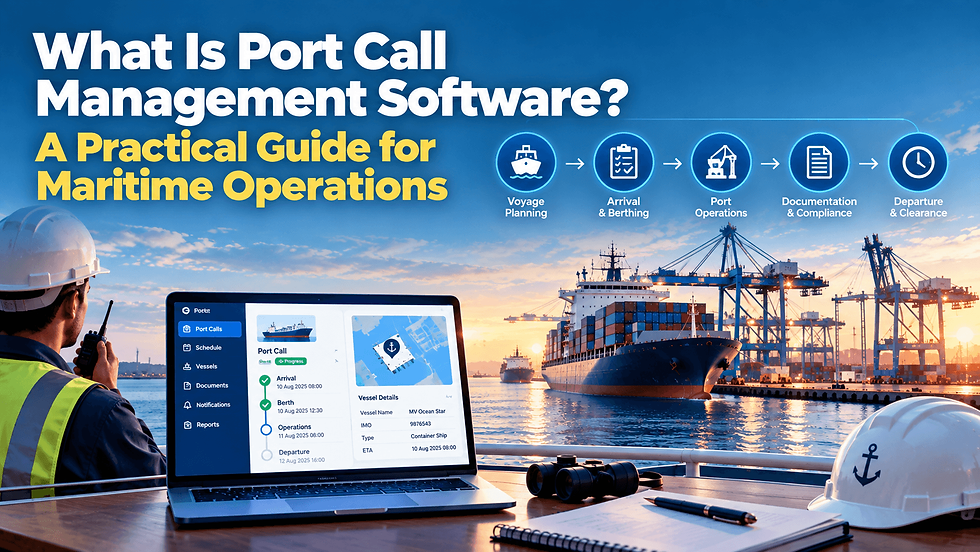
A typical port call can be thought of in three broad phases:
Before Arrival
Planning, communication, documentation, service coordination, and preparation.
During Port Stay
Arrival, berthing, cargo and service activities, stakeholder coordination, and operational monitoring.
After Departure
Documentation, reporting, invoice collection, reconciliation, and final port call accounting.
The shipping agent may be involved across all three phases..
This is why agency work is much broader than simply helping a ship enter a port.
Why Communication Is So Important
A shipping agent often operates in an environment where information changes quickly.
A vessel's estimated arrival time can change.
A berth may become unavailable.
A service provider may have a scheduling problem.
Cargo operations may take longer than expected.
A crew requirement may arise unexpectedly.
Each change can affect another part of the port call.
This makes communication one of the core functions of agency operations.
Traditionally, much of this communication has taken place through email, phone calls, messaging platforms, spreadsheets, and individual systems.
That can work.
But as the number of port calls increases, managing all of these communication channels becomes harder.
Why Port Agency Operations Can Become Complex
The complexity does not necessarily come from one difficult task.
It comes from the number of tasks happening at the same time.
Imagine a shipping agency managing multiple vessels across multiple ports.
Each vessel may have:
Different arrival times
Different service requirements
Different principals
Different cargo
Different vendors
Different authorities
Different documentation
Different financial transactions
The agency team has to keep track of all of these activities.
At small scale, people may manage this through personal knowledge, spreadsheets, email folders, and established relationships.
As the organization grows, that approach becomes increasingly difficult to scale.
The Hidden Data Problem
Every port call produces information.
There may be emails, quotations, service orders, invoices, statements, arrival information, departure information, crew documents, cargo details, and operational updates.
Individually, each piece of information may appear relatively simple.
Collectively, they represent a valuable operational dataset.
For example, an agency could potentially analyze:
How long vessels typically stay in each port
Which services are requested most frequently
Which suppliers are used most often
Where delays occur
How port call costs change over time
Which vendors consistently meet expectations
Which activities require the most manual coordination
But if this information is distributed across emails, spreadsheets, PDFs, and disconnected systems, extracting those insights becomes difficult.
This is where the difference between managing port calls and learning from port calls becomes important.
Shipping Agent vs Ship Manager
The two roles can sometimes be confused because both may be involved in vessel operations.
But their responsibilities are different.
A ship manager generally manages defined aspects of the vessel's broader operational requirements.
A shipping agent focuses on representing and coordinating the vessel's requirements within a particular port or local environment.
The ship manager may ask:
How do we maintain and operate the vessel effectively?
The shipping agent may ask:
How do we coordinate everything this vessel needs during this port call?
The two roles can work closely together.
The agent provides local coordination.
The ship manager provides broader operational direction.
Shipping Agent vs Port Authority
A shipping agent is also different from a port authority.
A port authority is responsible for functions associated with managing, regulating, or overseeing the port according to its legal and organizational mandate.
A shipping agent represents the interests and requirements of its principal within the port environment.
The agent may communicate with the port authority, but the two organizations have different roles.
Understanding this distinction is important because a port call involves multiple organizations with different responsibilities.
Where Technology Can Help Shipping Agents
Technology can reduce some of the administrative burden associated with port agency operations.
But the objective should not simply be to replace email with another interface.
A useful system should help connect the workflow.
For example, a digital platform could help an agency manage:
Vessel Information
Keep relevant vessel and port call information organized in one place.
Port Call Activities
Track activities before, during, and after the vessel's visit.
Service Coordination
Manage requests and communication with service providers.
Documents
Organize documents associated with the port call.
Financial Information
Connect services, invoices, expenses, and supporting documentation.
Notifications
Make important changes and pending activities visible to the right people.
Reporting
Provide management with a clearer view of port call activity across vessels and locations.
The value comes from connecting these workflows rather than simply digitizing individual tasks.
Why Scaling a Shipping Agency Is Difficult
A shipping agency can grow by adding more vessels, more ports, more principals, or more customers.
But operational complexity can grow at the same time.
The number of interactions increases.
The number of documents increases.
The number of vendors increases.
The number of financial transactions increases.
And the amount of information employees need to track increases.
This creates a common scaling challenge:
The business grows faster than the systems supporting it.
At that point, organizations often discover that experienced employees are holding important operational knowledge in their heads, inboxes, spreadsheets, and personal workflows.
That knowledge can be difficult to transfer and difficult to analyze.
From Port Agency Operations to Port Call Intelligence
The next stage is not simply putting every port call into software.
The larger opportunity is turning operational information into usable intelligence.
For example:
Instead of only recording that a vessel arrived late, the organization could analyze patterns in arrival delays.
Instead of only recording an invoice, it could analyze recurring costs.
Instead of only storing supplier information, it could understand supplier performance across port calls.
Instead of only tracking activities, it could identify where operational bottlenecks repeatedly occur.
This changes the role of technology.
The system is no longer just a place to store information.
It becomes a tool for understanding operations.
The Bigger Role of the Shipping Agent
A shipping agent sits close to one of the most information intensive moments in maritime operations: the vessel's interaction with the port.
That position creates both responsibility and opportunity.
The agent has to coordinate people, services, information, documents, and decisions.
The operational challenge is making sure these elements move together.
The technology challenge is making that information visible, connected, and useful.
As maritime organizations move toward more connected and intelligent operations, port agency workflows can become an important source of operational intelligence.
The future opportunity is therefore not simply:
"How can we digitize shipping agency work?"
It is:
"How can we use the information generated during every port call to make the next port call better?"
That is a much more valuable question.
FAQ
1. What does a shipping agent do?
A shipping agent represents and supports a vessel owner, ship manager, charterer, or other principal during a vessel's port call. Responsibilities can include coordinating authorities, port services, documentation, crew requirements, suppliers, and port call expenses.
2. Why does a vessel need a shipping agent?
A vessel may visit ports where its owner or manager does not have a local operational presence. A shipping agent provides local coordination with authorities, service providers, terminals, and other stakeholders.
3. What does a shipping agent do before a vessel arrives?
The agent may gather vessel and voyage information, coordinate required notifications and documentation, arrange services, and communicate with relevant port stakeholders before arrival.
4. What does a shipping agent do during a port call?
The agent coordinates services, communication, documentation, crew requirements, authorities, suppliers, and other operational activities required during the vessel's stay.
5. What happens after a vessel leaves the port?
Post departure activities can include collecting invoices and supporting documents, preparing reports, reconciling port call expenses, and completing other administrative requirements.
6. What is the difference between a shipping agent and a ship manager?
A ship manager manages defined aspects of a vessel's broader operations, while a shipping agent focuses primarily on representing and coordinating the vessel's requirements within a particular port or local environment.
7. Can shipping agents use AI and automation?
Yes. AI and automation can potentially support document processing, information extraction, workflow coordination, reporting, supplier analysis, and other repetitive activities when the underlying processes and data are suitable.